
 首页
 登录
 注册


-
Coherent energy transfer due to strong dipole-dipole coupling is an oscillatory exchange of excitation between the donor and acceptor molecules whose excited states have been entangled with each other, resulting in the delocalization of the excitation energy and the occurrence of quantum coherence [1-9]. Recently, people have utilized the technique of scanning tunneling microcopy (STM) induced luminescence (STML) that combines highly localized electron excitation and ingenious optical detection, to realize the real space investigation of coherent energy transfer between strongly coupled donor-acceptor molecules with the help of molecular manipulation ability of STM [10-12]. Nevertheless, the dynamic evolution of the plasmonic nanocavity (PNC) coupled donor-acceptor molecules system has not been studied systematically within the framework of the exciton theory, for example, how the PNC and dephasing impact on the coherent energy transfer process.
In this work, the time-dependent quantum master equation is used to study the coherent dynamics of the energy transfer in the PNC coupled donor-acceptor molecules system, which is triggered by the STM tunneling electrons. First, by using the model I present the resonant and non-resonant oscillatory energy exchange between the donor and acceptor molecules due to the strong dipolar-dipolar coupling, associated with symmetric and antisymmetric states. Next, I discuss the impact of molecular dephasing on the energy transfer between the coherently coupled donor-acceptor molecules and find that proper dephasing could increase the overall energy transfer efficiency via increasing the incoherent energy transfer while maintaining enough quantum coherence. Furthermore, I explore the dependence of PNC coupling strength on the energy transfer in the PNC coupled donor-acceptor molecules system and conclude that the increased interactions between the PNC and the molecules mainly enhance the energy dissipation of the donor and acceptor molecules, but not destroy the quantum coherence of the system. In addition, I describe the dynamic process and Fano feature of the PNC coupled donor-acceptor molecules system when the PNC is initially excited, which indicates that the energy transfer between the donor and acceptor molecules is caused by coherent intermolecular dipole-dipole coupling but not charge transfer. Finally, by entering the strong coupling regime between the molecules and PNC, I study the polariton-mediated energy transfer between the donor and acceptor molecules and confirm the existence of the indirect energy transfer channel mediated by polariton between the donor and acceptor molecules in addition to the direct donor-acceptor energy transfer channel by the dipole-dipole coupling. This work helps us to understand the coherent energy transfer in the PNC coupled donor-acceptor molecules system, and conclusions obtained from this work could offer the optimal design principle for complex artificial molecular systems in photosynthesis, optoelectronics, and quantum networks.
-
Within the exciton theory, the quantum master equation describing the PNC coupled donor-acceptor molecules system could be written as [13-18]
where
$ {H}_{0} $ is the Hamilton for the coupling free donor molecule, acceptor molecule and PNC,${V}_{\textrm{D-A}}$ ,${V}_{\textrm{D-PNC}}$ ,${V}_{\textrm{A-PNC}}$ are the interactions for donor-acceptor molecules, donor molecule-PNC, and acceptor molecule-PNC, respectively,$\rho ={\rho }_{\textrm{D}}\otimes {\rho }_{\textrm{A}}\otimes {\rho }_{\textrm{PNC}}$ is the density operator for the full system,${\mathcal{L}}_{\textrm{tun}}$ ,${\mathcal{L}}_{\textrm{damp}}$ and${\mathcal{L}}_{\textrm{deph}}$ are Liouvillian operators that describe the tunneling electrons induced excitation, various damping processes and the dephasing processes, respectively.The
$ {H}_{0} $ ,${V}_{\textrm{D-A}}$ ,${V}_{\textrm{D-PNC}}$ , and${V}_{\textrm{A-PNC}}$ that represent the coherent process could be expressed aswhere
${\widehat{\sigma }}_{\textrm{D},+} $ $\left({\widehat{\sigma }}_{\textrm{D},-} \right)$ is the excitation (de-excitation) operator for the donor molecular excitation,${\widehat{\sigma }}_{{\rm{A}},+}({\widehat{\sigma }}_{\rm{A},-})$ is the excitation (de-excitation) operator for the acceptor molecular excitation,${\widehat{a}}_{\textrm{PNC}}^{†}\ ( {\widehat{a}}_{\textrm{PNC}})$ is the creation (destruction) operator for the PNC,$\left|{g}_{\textrm{D}}\rangle\right.$ and$\left|{e}_{\textrm{D}}\rangle\right.$ ($\left|{g}_{\textrm{A}}\rangle\right.$ and$\left|{e}_{\textrm{A}}\rangle\right.$ ) are the ground and excite states of the donor (acceptor) molecule,$I$ is the unit operator,${g}_{\textrm{D-A}}$ ,${g}_{\textrm{D-PNC}}$ and${g}_{\textrm{A-PNC}}$ are the coupling strengths of donor-acceptor molecules, donor molecule-PNC and acceptor molecule-PNC, respectively,${\omega }_{\textrm{D}}$ and${\omega }_{\textrm{A} }$ are the electronic transition frequencies of the donor and acceptor molecules,${\omega }_{\textrm{PNC} }$ is the resonance frequency of the PNC. For simplicity, only a single-mode PNC is considered.The
${\mathcal{L}}_{\textrm{tun}}$ ,${\mathcal{L}}_{\textrm{damp}}$ , and${\mathcal{L}}_{\textrm{deph}}$ that represent the incoherent process could be expressed aswhere
${\gamma }_{\textrm{tun}}^{i\to j}$ is the tunneling electron induced transition rate from the i-th level to the j-th level of the full system,$ {s}_{ij} $ is the square matrix with the element (i, j) equal to 1 while all the other elements vanishing;$\mathcal{L}_{\textrm{D}}^{\textrm{total}}={\widehat{\sigma }}_{\textrm{D},-}$ ,$\mathcal{L}_{\textrm{A}}^{\textrm{total}}={\widehat{\sigma }}_{\textrm{A},-}$ , and$\mathcal{L}_{\textrm{PNC}}^{\textrm{total}}={\widehat{a}}_{\textrm{PNC}}$ are the jump operators for the decay of the donor molecule, the acceptor molecule, and the PNC, respectively,${\gamma }_{\textrm{D}}^{\textrm{total}}$ ,${\gamma }_{\textrm{A}}^{\textrm{total}}$ , and${\gamma }_{\textrm{PNC}}^{\textrm{total}}$ are the total (radiative plus non-radiative) decay rates of the donor molecule, the acceptor molecule, and the PNC, respectively;$\mathcal{L}_{\textrm{D}}^{\textrm{deph}}={\widehat{\sigma }}_{\textrm{D},+}{\widehat{\sigma }}_{\textrm{D},-}$ and$\mathcal{L}_{\textrm{A}}^{\textrm{deph}}={\widehat{\sigma }}_{\textrm{A},+}{\widehat{\sigma }}_{\textrm{A},-}$ are the jump operators for the dephasing of the donor and acceptor molecules,${\gamma }_{\textrm{D}}^{\textrm{deph}}$ and${\gamma }_{\textrm{A}}^{\textrm{deph}}$ are the dephasing rates of the donor and acceptor molecules.The
$ \rho \left(t\right) $ that describes the physical properties of the PNC coupled donor-acceptor molecules system could be obtained by solving the time-dependent quantum master equation [19]. The populations of the donor molecular exciton${P}_{\textrm{D}}\left(t\right)$ , the acceptor molecular exciton${P}_{\textrm{A}}\left(t\right)$ and the PNC${P}_{\textrm{PNC}}\left(t\right)$ , corresponding to the diagonal elements of the density matrix, could be evaluated asIn this work, the energy transfer efficiency between the donor and acceptor molecules can be quantified by the increased (decreased) population of acceptor (donor) molecular exciton owing to the dipolar couplings in the full system.
In addition, the emission spectra of the donor and acceptor molecules, and the PNC could be evaluated as
It should be noted that, since electron tunneling rate is much slower than the decay of the molecules or PNC in STML, at one side, when evaluating the time-dependent populations of the PNC coupled donor-acceptor molecules system, the
${\mathcal{L}}_{\textrm{tun}}$ term is ignored; at the other side, when evaluating the steady-state emission spectra of the donor and acceptor molecules, and the PNC, the${\mathcal{L}}_{\textrm{tun} }$ term is considered. Besides, the initial state of the full system is$\left|\Psi \left(0\right)\rangle=\left|{e}_{\textrm{D}}\rangle\otimes\right.\left|{g}_{\textrm{A}}\rangle\otimes\right.\left|{0}_{\textrm{PNC}}\rangle\right.\right.$ when the donor molecule is initially excited, while$|\Psi \left(0\right)\rangle= \left|{g}_{\textrm{D}}\rangle\otimes\right.\left|{g}_{\textrm{A}}\rangle\otimes\right.\left|1_{\textrm{PNC}}\rangle\right.$ when the PNC is initially excited. -
To make the numerical results more realistic, the experimental parameters in Refs. [10, 12, 20] are adopted in this work. Specifically, the total decay rates of the electronically decoupled donor and acceptor molecules, the PNC in the STM tunneling junction are
${\gamma }_{\textrm{D}}^{\textrm{total}}=0.007\;{\rm{eV}}$ ,${\gamma }_{\textrm{A}}^{\textrm{total}}=0.007\;{\rm{eV}}$ , and${\gamma }_{\textrm{PNC}}^{\textrm{total}}= 0.120\;{\rm{eV}}$ , respectively. The coupling strength of donor-acceptor molecules${g}_{\textrm{D-A}}$ that depends on the molecular transition dipole moment and the intermolecular distance, and the coupling strengths of donor molecule-PNC${g}_{\textrm{D-PNC}}$ and acceptor molecule-PNC${g}_{\textrm{A-PNC} }$ that depend on the lateral and vertical distances between the tip apex and the molecules, are listed in the captions of each figure. The dephasing rates of the donor and acceptor molecules,${\gamma }_{\textrm{D}}^{\textrm{deph}}$ and${\gamma }_{\textrm{A}}^{\textrm{deph}}$ , are usually zero, but${\gamma }_{\textrm{D}}^{\textrm{deph}}$ is set to be 0.002 eV in FIG. 1(b, d). In addition, the radiative decay rates of the molecules and the PNC are set as${\gamma }_{\textrm{mol}}^{\textrm{rad}}\approx {10}^{-8}\;{\rm{eV}}$ and${\gamma }_{\textrm{PNC}}^{\textrm{rad}}\approx 0.012\;{\rm{eV}}$ , respectively.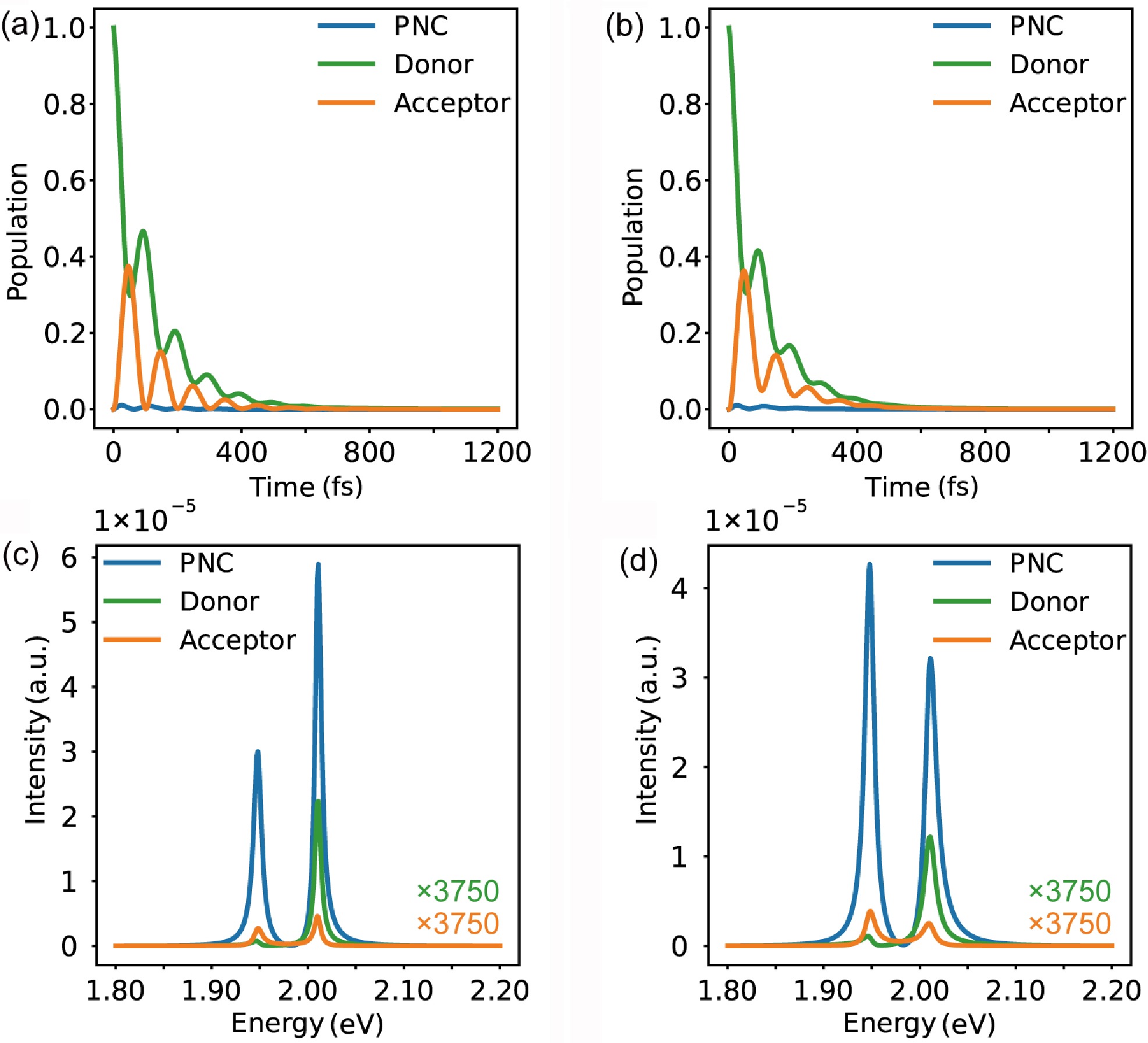
FIG. 2(a) illustrates the schematic of tunneling electrons triggered energy transfer in the PNC coupled donor-acceptor molecules system where the molecules are electronically decoupled to suppress substrate-induced energy dissipation for molecular excitons: the atomically confined tunneling current of the STM excites only the donor molecule, and then the excitation energy is transferred back and forth between the coherently coupled donor-acceptor molecules due to the strong dipole-dipole interaction, finally emitted to the far field via photons through the PNC acting as an antanna. The strong intermolecular dipole-dipole interaction,
${g}_{\textrm{D-A}} > \max({\gamma }_{\textrm{D}}^{\textrm{total}},{\gamma }_{\textrm{A}}^{\textrm{total}})$ , which could be reached by pushing the donor and acceptor molecules close enough while orientating the molecular transition dipoles in-line in-phase as much as possible via the STM tip manipulation, leads to the formation of two entangled delocalized states: a symmetric, superradiant state$\left|{\Psi }_{\textrm{S}}\rangle\right.$ and an antisymmetric, subradiant state$\left|{\Psi }_{\textrm{A}}\rangle\right.$ [10, 12, 21, 22]. For resonant energy transfer ($\left|{\omega }_{\textrm{D}}-{\omega }_{\textrm{A}}\right|= 0.00\ll \left|{g}_{\textrm{D-A}}\right|$ ), the degree of superposition of state$\left|{\Psi }_{\textrm{S}}\rangle\right.$ and$\left|{\Psi }_{\textrm{A}}\rangle\right.$ is maximal, corresponding to a higher energy transfer efficiency between the donor and acceptor molecules, as shown in FIG. 2(b); for non-resonant energy transfer ($\left|{\omega }_{\textrm{D}}-{\omega }_{\textrm{A}}\right|=0.04\;{\rm{eV}} > \left|{g}_{\textrm{D-A}}\right|$ ), the degree of superposition of state$\left|{\Psi }_{\textrm{S}}\rangle\right.$ and$\left|{\Psi }_{\textrm{A}}\rangle\right.$ is smaller, corresponding to a lower energy transfer efficiency, as shown in FIG. 2(c).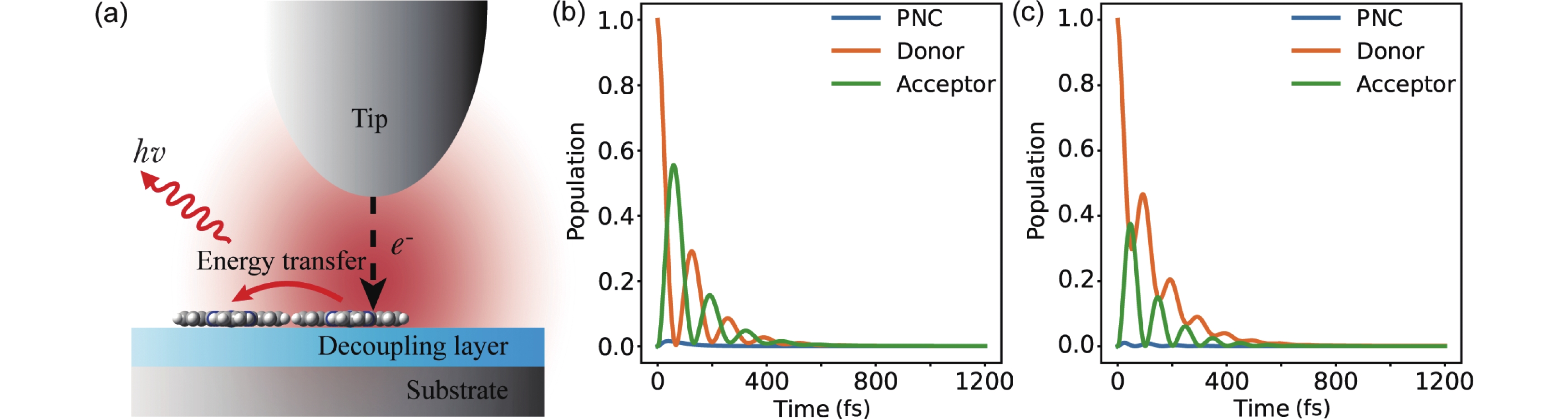
Interestingly, proper dephasing could increase the energy transfer efficiency via an incoherent energy transfer channel in the non-resonant energy transfer process. As shown in FIG. 1, when increasing the dephasing rate of the donor molecule from
${\gamma }_{\textrm{D}}^{\textrm{deph}}=0.000$ eV to${\gamma }_{\textrm{D}}^{\textrm{deph}}=0.002\;{\rm{eV}}$ , the overall energy transfer efficiency between the donor and acceptor molecules increases despite losing some quantum coherence. This could be understood that dephasing of the donor molecule makes it possible to match the energy detuning between the donor and acceptor molecules by releasing phonons, and then achieve the resonant energy transfer, which is also called dephasing-assisted energy transfer. Since dephasing arises from the decay of molecular vibrations due to the interaction with the environment, it indicates that vibronic excitons should play a role in the energy transfer between the coherently coupled donor-acceptor molecules here. What is more, since quantum coherence occurs in an intermediate regime of energy transfer where there is an intricate balance between quantum interference among electronic resonances and environment induced dephasing, it implies that proper dephasing may contribute to the high energy transfer efficiency in large complex quantum systems, where coherent and incoherent energy transfer may proceed synergistically [3-9, 23-29].Furthermore, the PNC coupling strength dependent energy transfer in the PNC coupled donor-acceptor molecules system is explored by increasing the coupling strengths of donor molecule-PNC and acceptor molecule-PNC,
${g}_{\textrm{D-PNC}}$ and${g}_{\textrm{A-PNC} }$ , from${g}_{\textrm{D-PNC}}= $ gA-PNC = 0.010 eV to gD-PNC = gA-PNC = 0.020 eV and then gD-PNC = gA-PNC = 0.040 eV. As shown in FIG. 3, as the PNC coupling strengths with the donor and acceptor molecules increase, the dissipation rates of the donor and acceptor molecules are significantly enhanced, or the transfer rates from molecules to PNC are dramatically accelerated, resulting in the increased emission intensities of PNC, during which the quantum coherence of the system is not destroyed. In fact, in this weak coupling (${\gamma }_{\textrm{D,A}}^{\textrm{total}}{\ll g}_{\textrm{D,A-PNC}}\ll {\gamma }_{\textrm{PNC}}^{\textrm{total}}$ ) and strong cooperativity ($C_{\textrm{D,A}}=4 g_{\textrm{D,A}}^2 / (\gamma_{\textrm{PNC}}^{\textrm{total}} \gamma_{\textrm{D,A}}^{\textrm{total}}) > 1$ , proportional to the Purell factor) regime, PNC has two functions that compete with each other: first, the decay rates of the donor and acceptor molecules can be largely increased because of the Purcell enhancement by the PNC, manifested as a bad cavity where the energy flow from the donor and acceptor to the PNC is promoted; second, the PNC can modify the energy transfer between the donor and acceptor molecules via the PNC mediated collective subradiant behaviors, which is, however, not so obvious here, probably overshadowed by the first “shining” function [30]. It is notable that, as the PNC coupling strengths with the molecules increase, the linewidths of the PNC emission peaks broaden, which originates from the nature of the fast decay rate of PNC.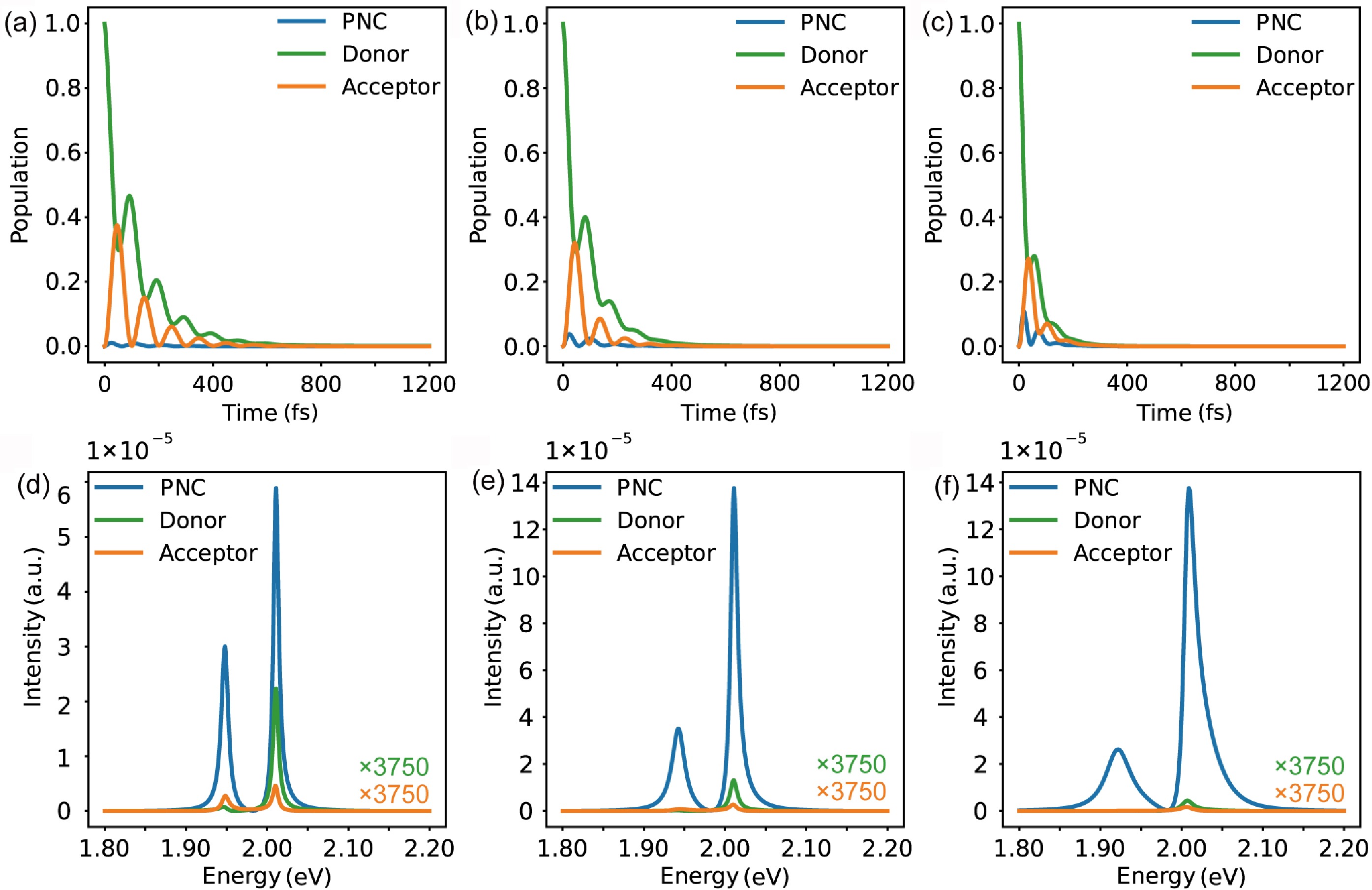
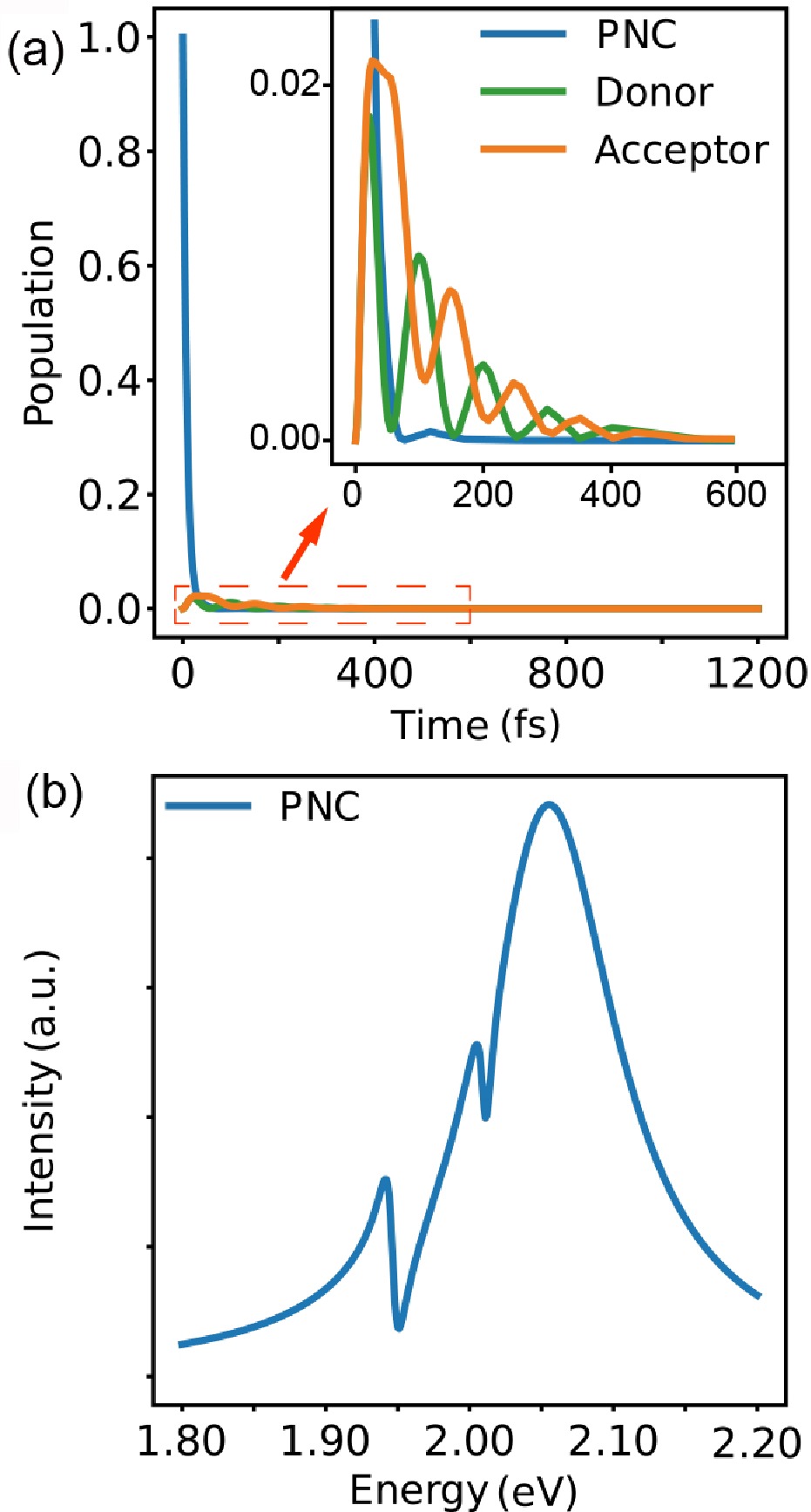
In addition, if the PNC is initially excited in the PNC coupled donor and acceptor molecules system, the Fano resonance occurs at two resonance frequencies of the coherently coupled donor-acceptor molecules, which are attributed to the symmetric and asymmetric states of the strongly coupled molecules. As shown in FIG. 4(a), on one hand, due to the dipolar coupling between PNC and molecules, the donor and acceptor molecules receive the energy from the PNC and then release it back to the PNC, repeatedly; on the other hand, because of the strong intermolecular dipole-dipole coupling, the donor and acceptor molecules transfer energy back and forth, forming the symmetric and asymmetric states. The coherent interaction between the sharp discrete excitonic states, that are the symmetric and asymmetric states, and the broad continuous state of PNC, leads to the occurrence of Fano resonance, as shown in FIG. 4(b) where two clear dips are superimposed over the PNC emission spectrum. Such a process, in turn, indicates that the mechanism of the energy transfer between the donor and acceptor molecules is coherent intermolecular dipole-dipole coupling, rather than sequential charge transfer [12, 20, 31, 32]. It should be pointed out that the dip around 2.0 eV is shallower than the one around 1.96 eV, even though the former has a smaller detuning with the plasmon frequency. This is because some other essential physical properties of the system dominate the coherent interaction between the molecules and PNC, or determine the Fano dip depth here, which is beyond the contents of this work and will be discussed in my future work.
Thanks to the microscopic quantum model, the polariton-mediated energy transfer between the donor and acceptor molecules in a strongly coupled PNC is considered, which belongs neither to the Förster nor the Dexter type energy transfer. Even though the PNC is not a good cavity (
${\gamma }_{\textrm{PNC}}^{\textrm{total}}=0.120\;{\rm{eV}}$ ), by orienting the molecular transition dipole perfectly aligned with the STM tip (along the electric field) in the PNC, it is accessible to reach the strong coupling regime with the PNC, that is${{(g}_{\textrm{D-PNC}},{g}_{\textrm{D-PNC}})}_{\min}\gg$ ${\gamma }_{\textrm{PNC}}^{\textrm{total}}$ [33]. FIG. 5(a) shows the time-dependent populations of the donor molecular exciton${P}_{\textrm{D}}\left(t\right)$ , the acceptor molecular exciton${P}_{\textrm{A}}\left(t\right)$ and the PNC${P}_{\textrm{PNC}}\left(t\right)$ in such a system, where the initially excited donor molecule exchanges energy with the PNC, and then with the acceptor molecule via the hybrid polaritonic states, a linear admixture of the donor molecular exciton, the acceptor molecular exciton and the PNC, due to the strong dipolar coupling of donor molecule-PNC and acceptor molecule-PNC. FIG. 5(b) shows the resulted steady-state emission spectrum of the PNC with the three hybrid polaritonic states: the upper (UP), middle (MP) and lower (LP) polaritonic states. This new energy transfer mechanism that the hybrid polaritonic states act as the efficient energy transfer pathway between the donor and acceptor molecules provides an insight into the coherent dipole-dipole energy transfer [34-36].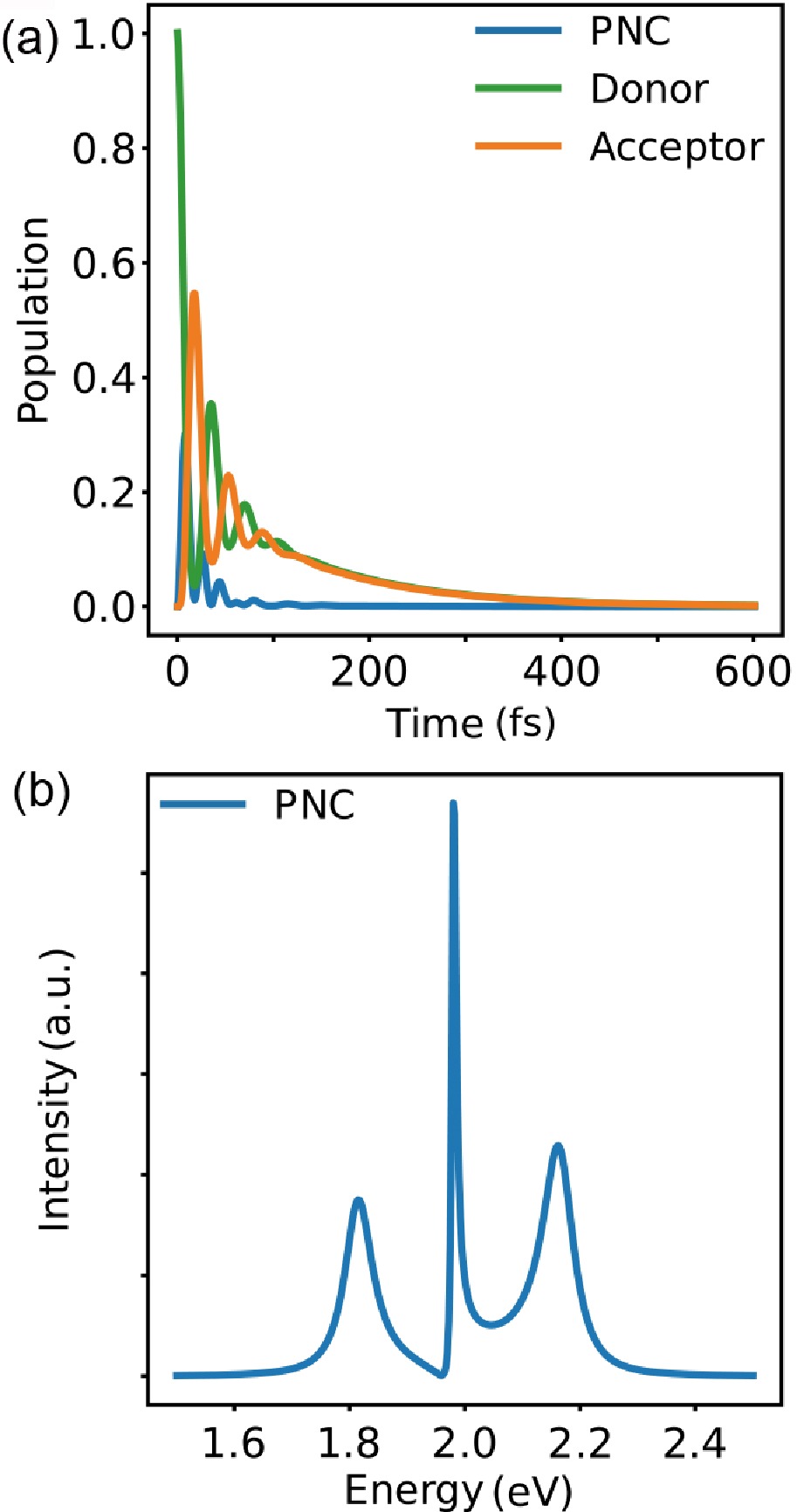
Finally, I would like to note that, since the point-dipolar approximation is adopted to model the interactions between the donor and acceptor molecules, molecules and PNC in this work, the simulated results may not cover all the details of the experimental observations but present the main features of the research object, such as FIG. 2, FIG. 3, and FIG. 4. On the other side, in this work the single variable method is used to simulate and discuss every topic, which is clear and convenient for understanding. However, in the experiment, several variables may be entangled with each other and correlated behaviors may appear. For example, in the experiment, the dephasing, the vibronic modes, the decay rates of molecules and PNC, and etc. may work together and present the emission intensities of the donor and acceptor molecules that are slightly different from the simulated results in FIG. 1 and FIG. 3 where only one variable is involved. In brief, the model in this work could help us quickly establish dynamic and steady-state physical pictures for the experimental phenomena; what is more, by designing and modifying the model, new experimental phenomena could be predicted, for example in FIG. 1 and FIG. 5.
-
In conclusion, by using the microscopic quantum model, I study theoretically various coherent dynamics of energy transfer in the PNC coupled donor-acceptor molecules system, including: (i) resonant and non-resonant energy exchange between coherently coupled donor-acceptor molecules associated with symmetric and antisymmetric states, which shows that resonant coherent energy transfer has a higher energy transfer efficiency than non-resonant coherent energy transfer; (ii) dephasing assisted energy transfer accompanying with an acceptable loss of quantum coherence via an incoherent energy transfer channel, which implies that at proper noise level, coherence and decoherence may collaborate to achieve a high energy transfer efficiency in a large complex quantum network; (iii) PNC coupling strength dependent energy transfer, which concludes that the increased interactions of PNC with the donor and acceptor molecules promote the energy flow from the molecules to the PNC, originating from the Purell enhancement of the decay rates of molecules; (iv) Fano resonance of the coherently coupled donor-acceptor molecules, which reveals the coherent interaction between the two delocalized excitonic modes and the PNC mode, and indicates that the energy transfer mechanism between the donor and acceptor molecules is coherent intermolecular dipole-dipole coupling but not charge transfer; (v) polariton-mediated energy transfer that does not follow the Förster resonance energy transfer (FRET) or the Dexter mechanisms, where energy is transferred between the donor and acceptor molecules via three delocalized hybrid states owing to the strong dipolar couplings of PNC to the molecules. The relations and mutual influence between the simulated results and the experimental measurements are also discussed. This work not only deepens our understanding of coherent energy transfer from dynamics but also provides guidance for designing artificial molecular systems with high energy transfer efficiency in photosynthesis, optoelectronics, and quantum networks.
Tunneling Electrons Triggered Energy Transfer between Coherently Coupled Donor-Acceptor Molecules
- Received Date: 27/10/2023
- Available Online: 27/08/2024
-
Key words:
- Energy transfer /
- Coherent energy transfer /
- Scanning tunneling microcopy induced luminescence /
- Plasmonic nanocavity /
- Quantum master equation /
- Dephasing /
- Fano resonance /
- Polariton-mediated energy transfer
Abstract: Energy transfer is ubiquitous in natural and artificial light-harvesting systems, and coherent energy transfer, a highly efficient energy transfer process, has been accepted to play a vital role in such systems. However, the energy oscillation of coherent energy transfer is exceedingly difficult to capture because of its evanescence due to the interaction with a thermal environment. Here a microscopic quantum model is used to study the time evolution of electrons triggered energy transfer between coherently coupled donor-acceptor molecules in scanning tunneling microscope (STM). A series of topics in the plasmonic nanocavity (PNC) coupled donor-acceptor molecules system are discussed, including resonant and non-resonant coherent energy transfer, dephasing assisted energy transfer, PNC coupling strength dependent energy transfer, Fano resonance of coherently coupled donor-acceptor molecules, and polariton-mediated energy transfer.
 DownLoad: