
 首页
 登录
 注册



HTML
-
The development of lead-free luminescent materials has attracted considerable attention due to increasing concerns about environmental sustainability and the demand for high-performance optoelectronic devices.[1–4] Among various alternatives, Cu(I)-based halides have emerged as promising candidates due to their outstanding photoluminescence quantum yield (PLQY), structural stability, and tunable emission properties.[5–7] Unlike traditional lead-halide perovskites, these materials exhibit excellent resistance to moisture and thermal degradation, making them highly suitable for long-term applications in lighting and display technologies. In particular, zero-dimensional (0D) Cu(I)-based halides,[8,9] such as (C12H24O6)2Na2(H2O)3Cu4I6, demonstrate unique self-trapped exciton emission, enabling broadband PL with high quantum efficiency.[10] Despite these advantages, optimizing their luminescent properties and understanding their fundamental emission mechanisms remain essential for practical applications.
High-pressure techniques provide a powerful means to manipulate the structural and electronic properties of luminescent materials.[11–14] By applying hydrostatic pressure, interatomic interactions can be precisely tuned, allowing for fine control over emission wavelength, intensity, and efficiency.[4,15] Recent studies have shown that pressure can significantly influence the electronic structure of Cu(I) halides by altering metal-ligand coordination environments, inducing charge transfer effects, and strengthening cuprophilic interactions.[16] However, the detailed PL mechanisms governing the pressure-dependent behavior of 0D Cu(I)-based halides remain largely unexplored. Gaining a deeper understanding of how pressure affects emission pathways and energy level distributions is crucial for advancing knowledge of their PL behavior and facilitating the rational design of next-generation optoelectronic materials.
Here, we systematically investigate the pressure-dependent optical properties of (C12H24O6)2Na2(H2O)3Cu4I6 using in situ high-pressure PL, UV/Vis absorption, infrared (IR) spectroscopy, and Raman spectroscopy. By correlating structural evolution with optical responses under high pressure, we clarify the interaction between cuprophilic interactions and through-space charge-transfer (TSCT). Our findings reveal a complex PL modulation mechanism characterized by pressure-dependent blue- and red-shift behaviors, highlighting the crucial role of electronic structure rearrangement in tuning PL properties. This study deepens the understanding of high-pressure modulation in Cu(I)-based halides and lays the groundwork for the development of pressure-tunable luminescent materials for optoelectronic applications.
-
In (C12H24O6)2Na2(H2O)3Cu4I6, the C12H24O6 ether coordinates with Na+ and two crown-ether metal complexes are connected by two H2O molecules. The individual [Cu4I6]2− octahedron is surrounded by (C12H24O6)Na+ cations and water molecules, while coordination for the linkage between inorganic and organic building blocks is abundant hydrogen bond interaction (Fig. 1(a)).[17,18] In addition, the Cu–Cu distance in (C12H24O6)2Na2(H2O)3Cu4I6 (2.71 Å) is almost the same as the Cu–Cu distance (2.63–2.79 Å) in the reported cluster-centered (CC) and metal-to-ligand charge transfer (MLCT) or halide-to-ligand charge transfer (HLCT) mechanisms. According to existing reports and models, it is difficult to accurately determine whether the high-energy emission is attributed to HLCT or MLCT; therefore, we think it is more reasonable to attribute it to MLCT/HLCT.[19]
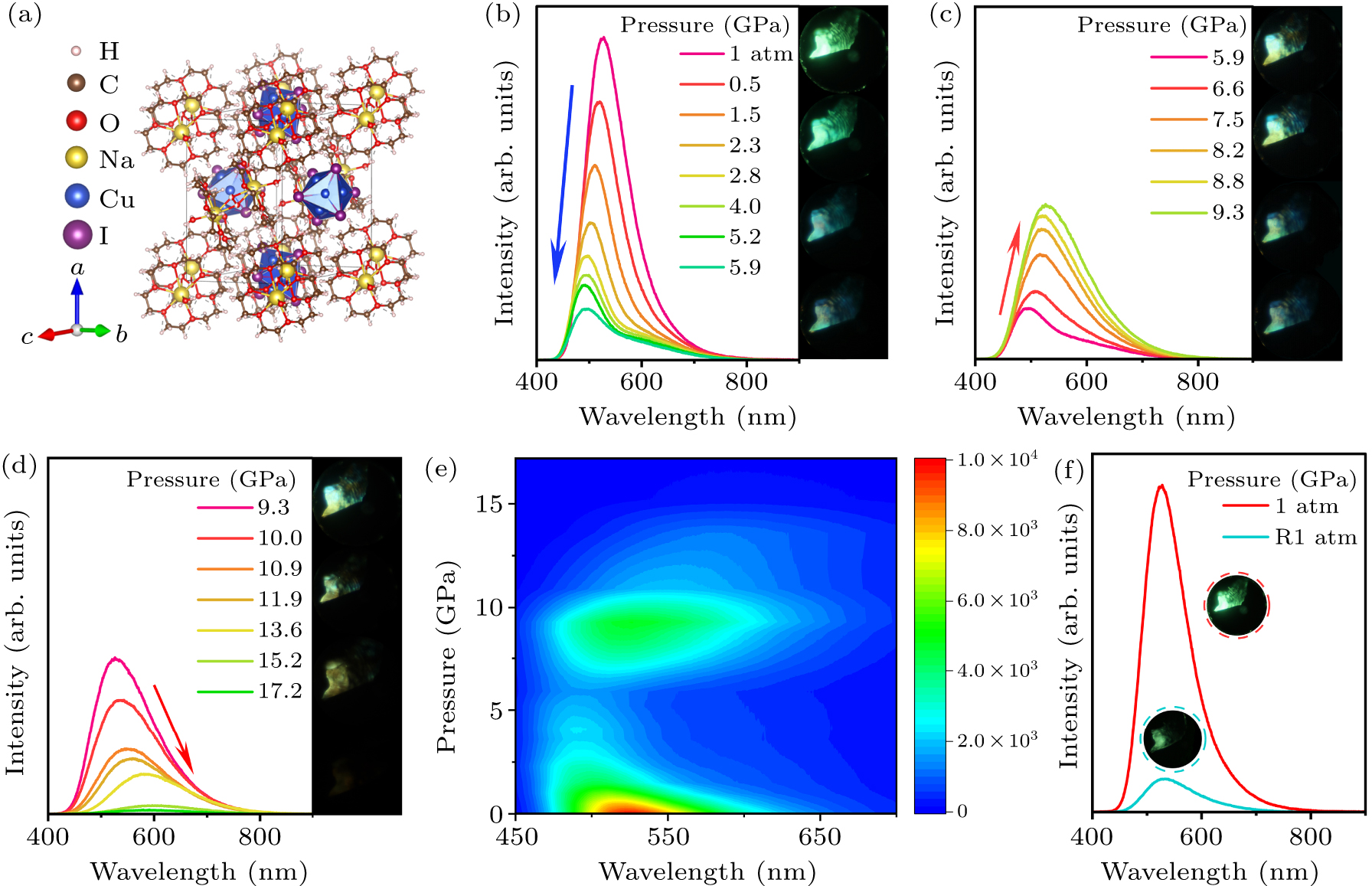
In order to better understand the emission characteristics of (C12H24O6)2Na2(H2O)3Cu4I6, we primarily conducted high-pressure PL experiments. In situ high-pressure PL experiments reveal non-monotonic variations in emission properties. With the increase in pressure, the original emission at 525 nm decreased below 5.9 GPa, accompanied by the blue shift of the emission peak (Fig. 1(b)). After that, the emission intensity gradually increased from 5.9 GPa to 9.3 GPa, and the entire PL intensity was remarkably decreased compared to the PL intensity at ambient conditions, accompanied by the red shift of the emission peak (Fig. 1(c)). It was observed that the emission intensity decreased again, with the emission peak remaining redshifted between 9.3 GPa and 17.2 GPa (Figs. 1(d) and 1(e)). When the pressure was completely released, the emission intensity was significantly decreased compared to its original state, while the emission wavelength remains unchanged (Fig. 1(f)). Low-dimensional Cu-based halides exhibit complex luminescence behavior under high-pressure due to their unique electronic structures and optical properties.[20,21]
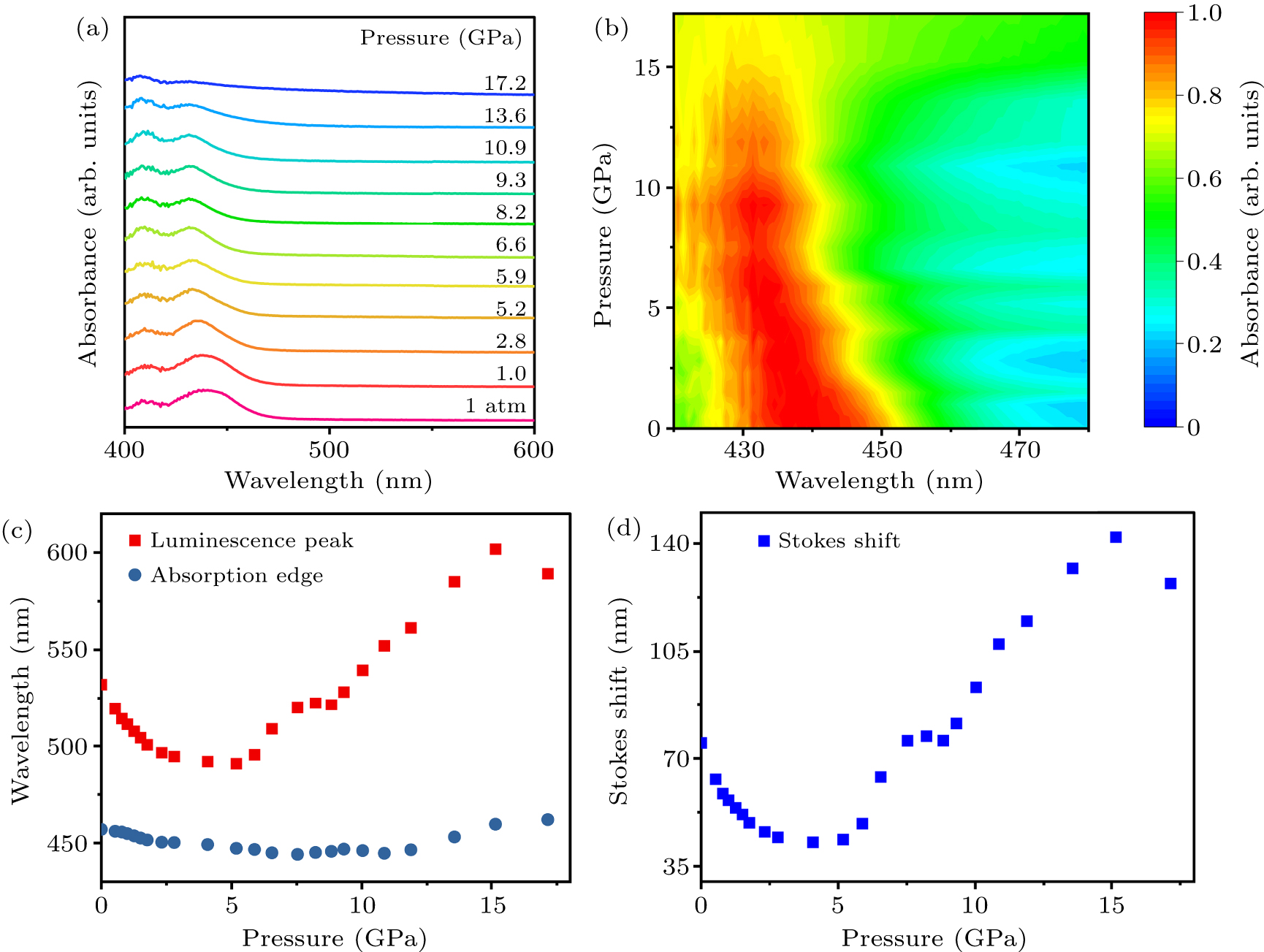
The band gap can reflect ground state properties of (C12H24O6)2Na2(H2O)3Cu4I6, so we carried out high-pressure UV/Vis absorption experiments (Figs. 2(a) and 2(b)). Under ambient conditions, the absorption edge (C12H24O6)2Na2(H2O)3Cu4I6 was located at 457 nm, with a longer wavelength absorption tail. With increasing pressure, the absorption edge underwent a blueshift, corresponding to an increase in the bandgap energy.[22] Between 5.9 GPa and 9.3 GPa, the absorption edge remained unchanged, indicating a relatively stable electronic structure in this pressure range. When pressure exceeded 9.3 GPa, the absorption edge underwent a redshifted trend with a decreased band gap. This was attributed to stronger through-space interactions between the anionic [Cu4I6]2 cluster core and the organic cations, leading to the redshift of the absorption edge. Combined with the luminescence peaks, it was found that the Stokes shift of (C12H24O6)2Na2(H2O)3Cu4I6 decreased below 5.9 GPa and increased consistently above 5.9 GPa (Figs. 2(c) and 2(d)). The change of Stokes shift reflected a variation of electronic structure, leading to the rearrangement of the excitation energy levels and emission energy levels.[23–25]
To further clarify the PL behavior, the emission clearly splits into different subbands, that is, a metal-to-ligand charge transfer or a halide-to-ligand charge transfer (MLCT/HLCT) excited state leads to high-energy emission at 522 nm and a cluster-centered (CC) excited state leads to low-energy emission at 576 nm. With the increase in pressure, MLCT/HLCT emission intensity weakens, with the blueshift of the emission wavelength. When the pressure exceeds 6 GPa, its emission wavelength redshifts with the intensity strengthening followed by weakening. In contrast, the CC-related emission wavelength remains unchanged below 10 GPa but shifts toward lower energy (redshift) beyond this threshold. CC emission follows the same trend as MLCT/HLCT emission intensity, and the intensity becomes gradually the same with the increase in pressure (Figs. 3(a) and 3(b)).
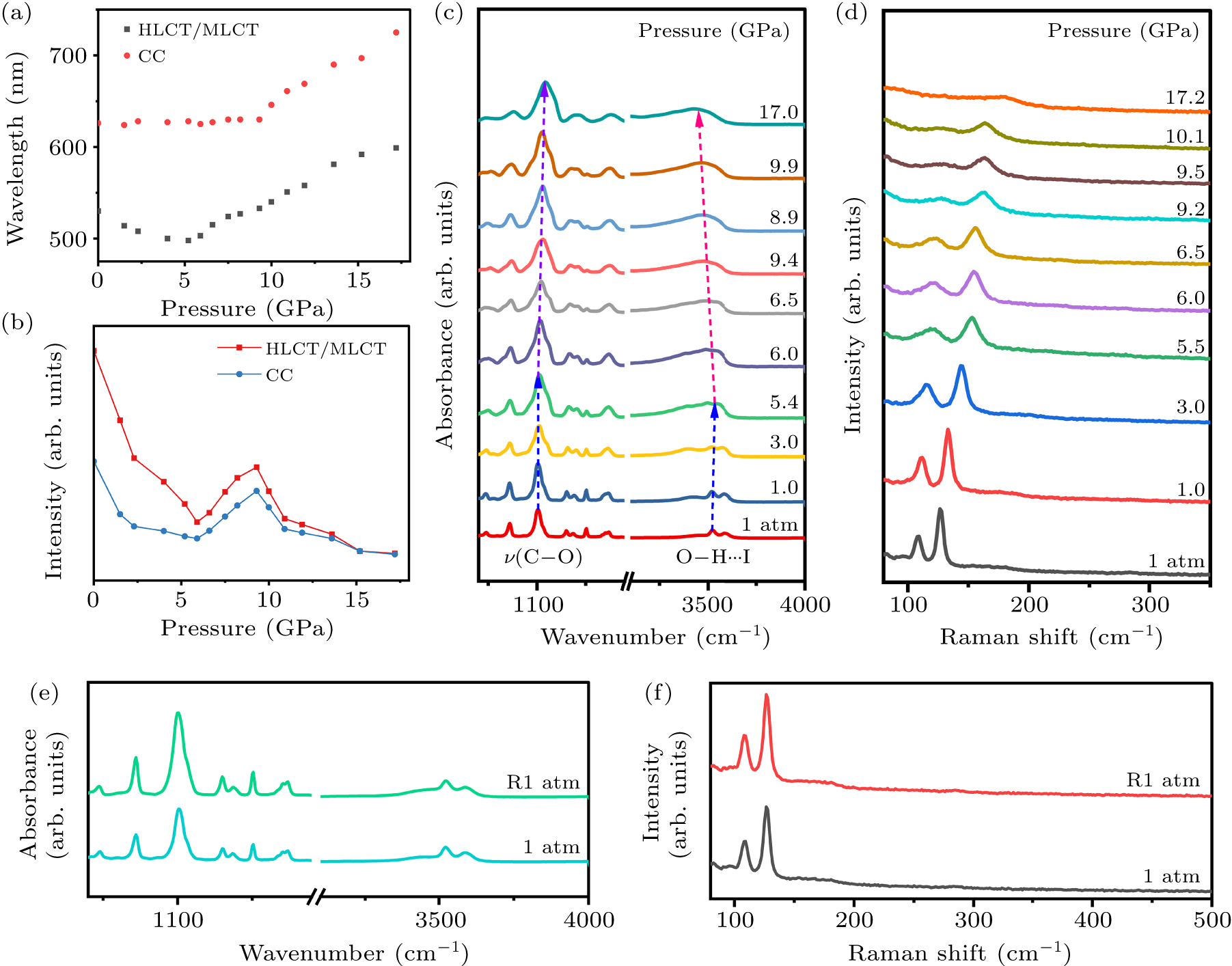
High-pressure IR tests and Raman spectroscopy tests provide further insight into the microstructural evolution of the (C12H24O6)2Na2(H2O)3Cu4I6. Analysis of O–H⋯I and CO vibrational modes reveals that pressure significantly alters intermolecular interactions (Fig. 3(c)). In the low-pressure regime (below 5.4 GPa), the original O–H⋯I interactions become weaker, strengthening the hydrogen bonding vibrations under pressure. The strengthened vibrations lead to an increase in MLCT/HLCT energy levels and contribute to the observed luminescence peak blueshift. When pressure exceeds 5.4 GPa, the vibrational peak of the CO bond blueshifts, while the Raman shift of the radial breathing mode (RBM) between 100 cm−1 and 150 cm−1 moves to higher frequencies (Fig. 3(d)).[26] The strengthened vibration of CO bonds and organic cation layers affects hydrogen bonding interactions, resulting in the weakening of MLCT/HLCT emission energy and an eventual PL redshift. At higher pressures (above 9.4 GPa), the vibration of the O–H⋯I redshifts, which is attributed to the effect of the hydrogen bonding vibrations by the strengthening of the Cu–Cu interactions. When the pressure was completely released, the locations of vibrational peaks in the IR and Raman spectra of (C12H24O6)2Na2(H2O)3Cu4I6 revert to their ambient-pressure states, explaining the reason for the unchanged emission wavelength. Although the vibrational peaks revert to their ambient-pressure positions, the molecular lattice does not fully recover. Enhanced coupling of some specific lattice vibrations to infrared radiation leads to enhanced infrared and Raman vibrational peaks. This distortion in the [Cu4I6]2− cluster and the organic cation layers decreases the radiative recombination, thus leading to a permanent decrease in emission intensity.[27]
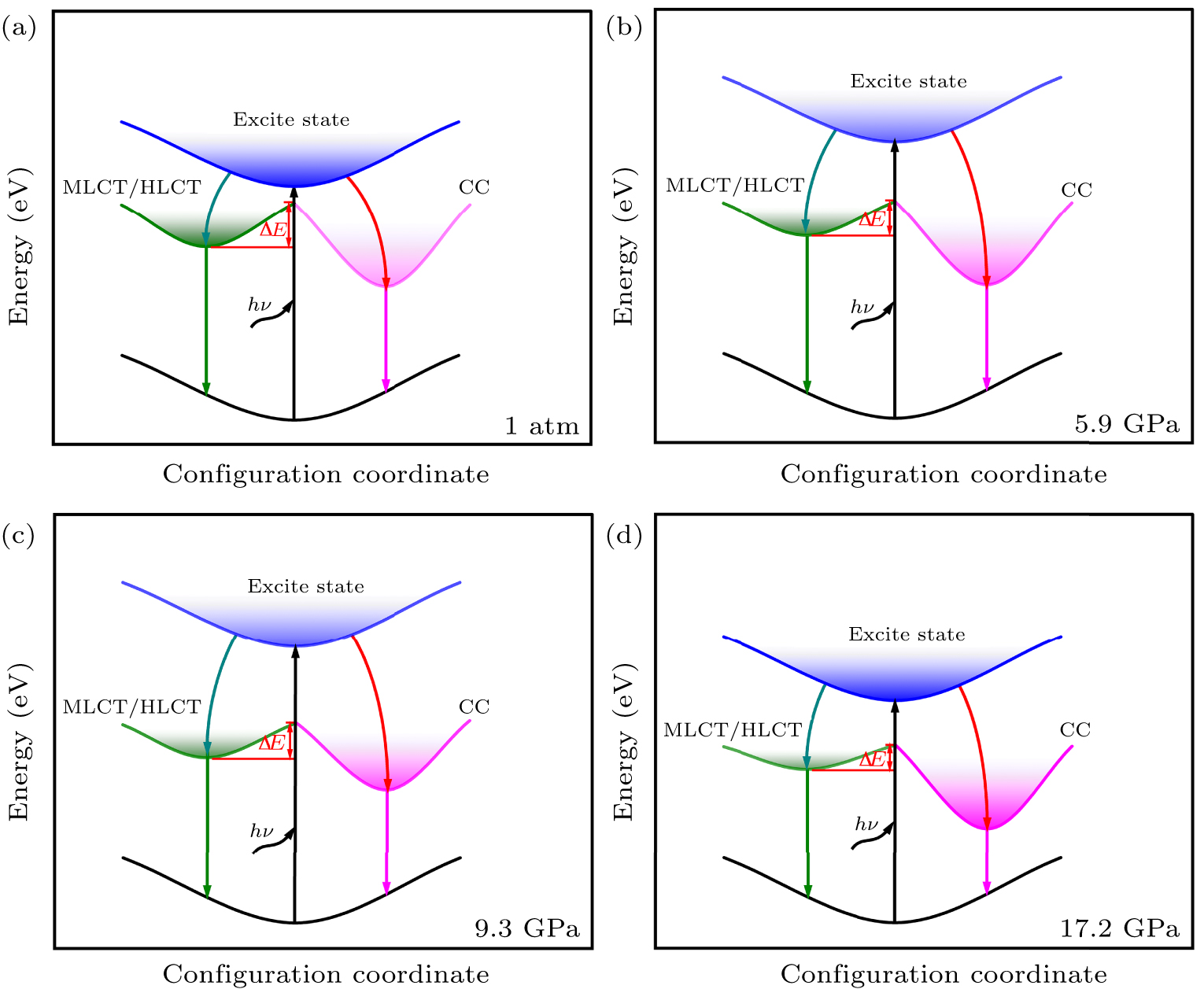
By synthesizing the experimental data, we propose a model describing the evolution of the electronic structure of (C12H24O6)2Na2(H2O)3Cu4I6 under different pressure conditions (Fig. 4(a)). Below 5.9 GPa, lattice distortion induces non-radiative recombination, leading to the gradual decrease in the emission intensity.[28] Simultaneously, bandgap widening reduces electron excitation probability, causing a blueshift in the absorption edge. At this stage, a potential barrier between the MLCT/HLCT and CC energy levels inhibits electronic transition.[29] Consequently, a greater proportion of electrons remain in the MLCT/HLCT state, undergoing radiative recombination, which strengthens the emission intensity of high-energy emission peaks relative to low-energy ones, resulting in an overall blueshift (Fig. 4(b)).[30] Above 5.9 GPa, enhanced electron–phonon coupling promotes radiative recombination, leading to the strengthening of emission intensity.[31,32] As the change of the hydrogen bond alters the electronic structure, the barrier height (ΔE) between the emitting states is lowered. The decrease in the barrier height between MLCT/HLCT and CC energy levels facilitates electron relaxation to the CC state, thereby strengthening low-energy CC emission while weakening MLCT/HLCT emission. This shift in emission dynamics leads to an overall redshift of the synthesized luminescence peak. Since the excited-state energy levels remain relatively unchanged, the Stokes shift increases accordingly (Fig. 4(c)). At pressures exceeding 9.3 GPa, increased non-radiative recombination causes weakened emission intensity. Concurrently, the shortened Cu–Cu bond increases electron cloud overlap, leading to bandgap narrowing and a further redshift in CC emission.[33] The continuous decrease in the barrier height further promotes electron relaxation to the CC state, mitigating the weakening of low-energy emission intensity and contributing to a sustained redshift in the emission peak (Fig. 4(d)).
-
In conclusion, we used hydrostatic pressure to tune the changes in cuprophilic interactions and through-space charge-transfer (TSCT). We observed the redshift and enhancement of luminescence between 5.9 GPa and 9.3 GPa and studied the corresponding structure-property relationships. With the rearrangement of MLCT/HLCT-related emission state and CC-related emission state, we proposed a fundamental excited-state relaxation model to account for the mechanism behind the redshifted and enhanced emission of (C12H24O6)2Na2(H2O)3Cu4I6 under pressure. Pressure drove electron relaxation to the CC state from MLCT/HLCT state, thereby strengthening low-energy CC emission while weakening MLCT/HLCT emission, leading to the redshift of the luminescence peak. Simultaneously, enhanced electron–phonon coupling promoted radiative recombination, leading to the strengthening of emission intensity. Our results demonstrate that the optical properties of low-dimensional Cu-based halides exhibit complex variations across different pressure regimes, highlighting the critical role of electronic structure modulation in the development of next-generation tunable optoelectronic devices.
 DownLoad: